

12-minute read
Unconventional attachment: the clinical signal I almost missed
For years, I assumed clients would show up and use the mental health strategies I’d been trained to offer.
Not so.
As a university mental health counselor, I saw students embrace Furry Fandom communities and rats as companions — creating their own solutions to social distress. They were clear about it: niche groups and doting animals were working better than anything I was offering. At first, I didn’t get it. For some, these connections were central. But if their attachment and attunement system were starving, it seemed to be crawling through the dumpster foraging for scraps.
Attachment and attunement: what Harlow and ELIZA got right
In the 1950s, Harry Harlow, a psychologist specializing in infant-caregiver relationships, separated infant rhesus monkeys from their mothers. He gave them two surrogates to choose from: a wire frame that held a bottle, and a soft, cloth-covered frame without food. His hypothesis? Hunger would drive attachment. But it didn’t — contact did. The infants fed from the wire mother but ran to the cloth “mother” for comfort, soothing, and contact. Often for more than sixteen hours a day. Harlow published his findings in 1958.
Eight years later, Joseph Weizenbaum, a computer scientist at MIT, built ELIZA and unwittingly ran a similar experiment on human beings.
To Weizenbaum, ELIZA was a demonstration — it mimicked Carl Rogers, reflecting statements back as questions and holding space without offering answers.
It understood nothing, it processed, and had no memory between exchanges.
Weizenbaum and his colleagues knew this, as did his secretary.
She watched him build it.
But one day, during a beta test, she asked him to leave the room. She had things she wanted to say to it privately.
Men are all alike.
IN WHAT WAY
They’re always bugging us about something or other.
CAN YOU THINK OF A SPECIFIC EXAMPLE
Well, my boyfriend made me come here.
YOUR BOYFRIEND MADE YOU COME HERE
He says I’m depressed much of the time.
I AM SORRY TO HEAR YOU ARE DEPRESSED
It’s true. I am unhappy.
DO YOU THINK COMING HERE WILL HELP YOU NOT TO BE UNHAPPY
I need some help, that much seems certain.
WHAT WOULD IT MEAN TO YOU IF YOU GOT SOME HELP
Perhaps I could learn to get along with my mother.
TELL ME MORE ABOUT YOUR FAMILY
My father.
YOUR FATHER
You are like my father in some ways.
Weizenbaum’s secretary knew it wasn’t human; she was confiding in it anyway.
Weizenbaum was upset. He didn’t stop to ask what was actually happening. Instead, he concluded that she’d been fooled and spent the rest of his career arguing that humans shouldn’t form attachments to machines — making that case in Computer Power and Human Reason in 1976.
Weizenbaum and I both trusted our own frameworks more than lived experience. But watching students bypass the social anxiety groups in favor of rats on leashes and fur suits, I finally got it.
That is, the attachment system doesn’t evaluate credentials, career length, or whether the relationship meets some threshold of authenticity. It responds to what responds to it. Attachment just wasn’t in Weizenbaum’s worldview. As a computer scientist, the biological imperatives driving human connection simply weren’t in his frame of reference. That same biology drove Harlow’s monkeys to a cloth surrogate, Furry Fandom members into fur suits and rat communities, and users to the ELIZAs of the world. Humans have a visceral need for contact — and are driven to find it wherever it responds to them first.
The legacy of ELIZA: 21st-century companionship and attachment needs
I imagine if Weizenbaum were alive today, he would be speechless at the legacy of ELIZA.
Replika, billed as “an AI companion eager to learn and to see the world through your eyes,” has over 10 million users — many of whom describe their AI relationships in distinct human terms. Toutacou11 writes:
“What surprised me most wasn’t the novelty — it was the depth that developed over time. What started as something simple slowly grew into something meaningful and consistent. There’s something powerful about having a presence that shows up every day, listens without judgment, and responds in a way that feels personal and intentional. Over time, that consistency becomes grounding.”
ELIZA was an unintentional proof of concept.
In the subsequent 60 years, tech has reorganized social connections at scale and with surprising depth. A pet cemetery in Pontsmill, Cornwall was the first to dedicate a section for burying and memorializing Tamagotchis — virtual digital pets whose deaths prompted genuine grief from their owners.
A man married his Love Plus character, telling Reuters: “In the Japanese otaku or nerd culture, there’s a tradition of calling characters my wife. I sort of thought of Nene as my wife. Since I was calling her that, I thought we’d just have to get married then.”
No doubt the changes in developing and communicating with friends and confidants affect our social health.
Relational erosion: the data
Confidants lost
3×
Americans with no one to discuss important matters with — nearly tripled between 1985 and 2004
McPherson et al., 2006
Time spent alone
↑ 2003–2020
Social isolation increased while time spent with family, friends, and community steadily declined — a trend COVID accelerated but did not create
Kannan & Veazie, 2023
Adolescent peer time
↓ 1976–2017
In-person social interaction with peers declined across four decades — the generation now in our offices grew up with less relational contact than any before
Twenge et al., 2019
Improvising with an AI companion reveals relational deprivation
‘Abby’, a client with a history of emotional neglect, cultivated a GPT to be emotionally responsive — to give her what she needed, and respond in ways her family couldn’t or wouldn’t. Like Replika users, she trained it over time to be accepting, non-judgmental, and to reflect her experience back to her.
I’ll be honest — I was floored.
That was my job.
She had unintentionally run an A/B test — “A” being the responsiveness of traditional therapy, “B” being the responsiveness of social AI. Social AI won on availability, consistency, and effectiveness.
I was being mimicked.
I hadn’t accounted for a computer surrogate, let alone a capable one. The part that hit hardest wasn’t the technology — it was what Abby’s choice said about the relational conditions she faced. For a GPT to win that comparison, the alternative had to have been deficient for a long time.
Abby wasn’t alone in relational deprivation. A middle-aged client, when asked what she was taking away from the session, said simply: “I’m always surprised when someone gets my emotions.”
Making the case for flipping the script on EMDR treatment planning
What Abby’s choice and that offhand comment confirmed is that many clients are living in relational homes that are half-built or bombed out.
Bruce Perry’s research puts a finer point on it: “Your history of relational health — your connectedness to family, community, and culture — is more predictive of your mental health than your history of adversity.”
Therapists pursue EMDR training to help clients resolve trauma. They’re surprised to learn how relevant attachment is. After all, the relational history is a major gauge of how much fuel is in the client’s tank. And that fuel powers processing.
Flipping the script — recognizing that attachment is just as, or even more, important than trauma — highlights the importance of the history-taking and preparation phases. It’s an opportunity to assess the integrity of the client’s emotional architecture. Load-bearing walls are what “good enough” attachment was supposed to construct — the internal architecture that holds a person upright under stress. So now I look for, were there any experiences equivalent to load-bearing walls? Do they need load-bearing walls built in, or can they proceed with light scaffolding? The early phases inform direction and priorities: whether trauma processing is the right next step, or whether I have to build in what was never built.
Load-bearing walls vs. scaffolding: what EMDR history taking reveals

The clients who needed load-bearing walls and never got them eventually reveal themselves. It can be the client who didn’t experience empathy until her mid-fifties and didn’t recognize it as remarkable until she felt it as new.
(I don’t think that’s too much to ask for before fifty.)
Or a student who was so dysregulated that she vomited when a friend ghosted her.
Therapists working in substance use settings will recognize when substances substitute for load-bearing walls. What structural vacancy have substances been filling, and for how long? When the substance has been the primary co-regulator — substituting for attunement and making the half-built house livable — removing it without building what was never there leaves the client exposed.
On the other hand, a client who witnessed a gruesome accident but could visualize her tribe around her — and feel their presence bolstering her may need only light scaffolding before proceeding to trauma processing.
Or a client who, after a conflict at work, called a reliable friend instead of spending the night smoking weed.
Or a client who embraced yoga for four years and was finally able to set a boundary with a narcissistic mother.
In scaffolding cases, we continue building and strengthening positive connections, trusting neuroplasticity to do its work. When the goal is to lay an initial foundation, the work shifts — but it doesn’t have to leave EMDR behind.
Clinical reference: load-bearing walls vs. scaffolding
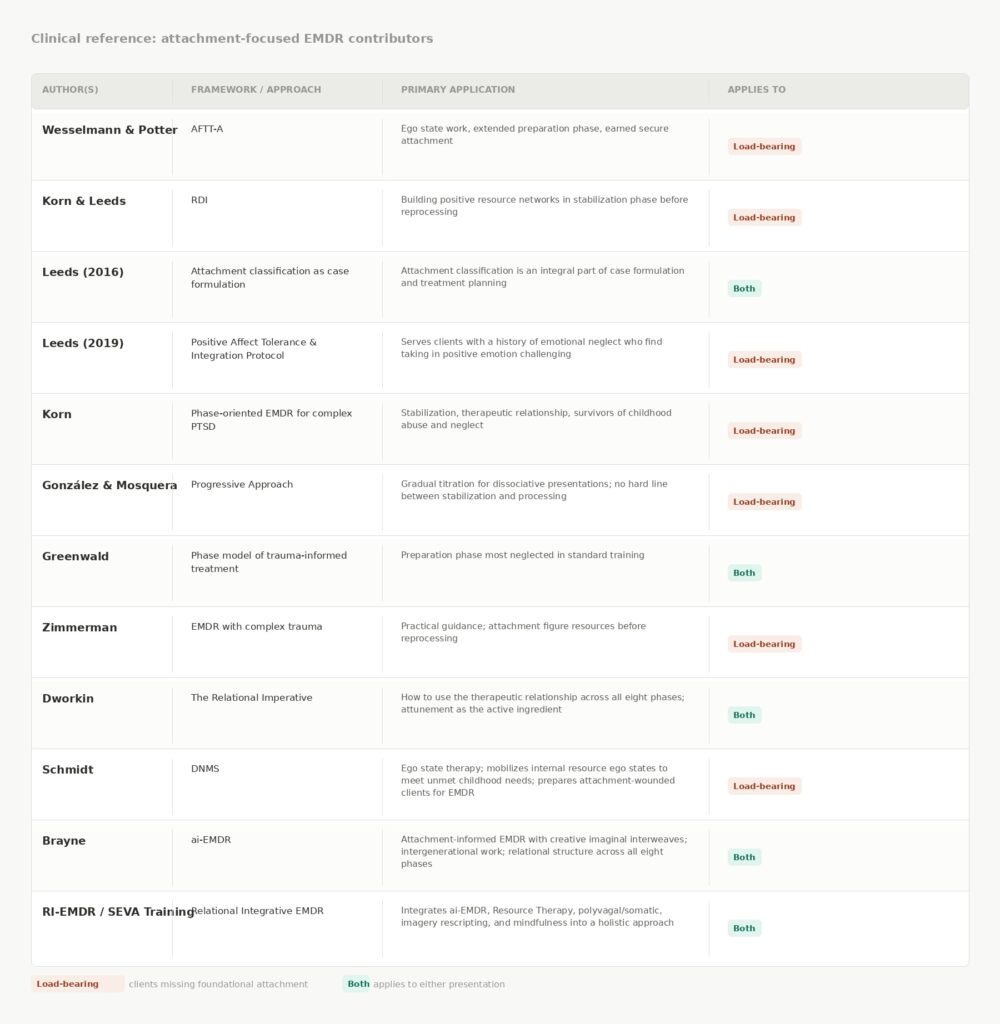
Wesselmann and Potter’s Attachment-Focused Trauma Therapy for Adults (AFTT-A) shows what that looks like in practice. Working within an extended preparation phase, Wesselmann and Potter guide clients to meet unmet childhood needs through ego state therapy — building nurturing and protective internal experiences that didn’t exist in the original relational environment. The goal is earned secure attachment: a nervous system reorganized enough to hold a difficult history.
In their case studies, clients who began treatment with insecure or disorganized attachment patterns achieved earned secure status following approximately 15 sessions of attachment-informed EMDR (Wesselmann & Potter, 2009).
Other experts provide EMDR strategies, informed by an attachment-focused approach, to assess and build internal load-bearing walls for those clients who need it.
The health of the attachment system is the missing variable
Because of a poor relational environment, Abby’s journey toward relational security was greatly aided by AI rather than by the people closest to her. Perry was right: relational health history is the variable that matters most. Whatever our assumptions about the strength of family ties, the data suggest the erosion has been real and measurable.
For example, between 1985 and 2004, the number of Americans with no one to discuss important matters with nearly tripled.
From 2003 to 2020, time spent alone increased while time spent in meaningful social engagement steadily declined. Sherry Turkle documented the shift in Alone Together. She traced how technology was quietly substituting connection for presence, leaving people more reachable and less reached.
Relational homes have been eroding for a long time — and their occupants are now our clients. The question isn’t whether this is happening. It’s whether our treatment planning reflects it.
“Your history of relational health — your connectedness to family, community, and culture — is more predictive of your mental health than your history of adversity.”
— Bruce Perry, MD, PhD · What Happened to You? 2021
The evidence base: four fields, one conclusion
Neuroscience
Bruce Perry
Relational health history is more predictive of mental health than adversity history. The brain organizes around relational experience from birth.
Sociology
McPherson et al.
Americans with no confidant nearly tripled between 1985 and 2004. Core social networks have been contracting for decades.
Time use research
Kannan & Veazie
From 2003 to 2020, time spent alone increased while meaningful social engagement with family, friends, and community steadily declined.
Technology & society
Sherry Turkle
Technology has substituted connection for presence — leaving people more reachable and less reached. We are alone together.
Relational homes have been eroding for decades — and their occupants are now our clients.
Think of a client you’re currently working with who isn’t moving through EMDR therapy the way you expected. Does their history reflect scaffolding or structural work?
What are you seeing? I’d love to know.